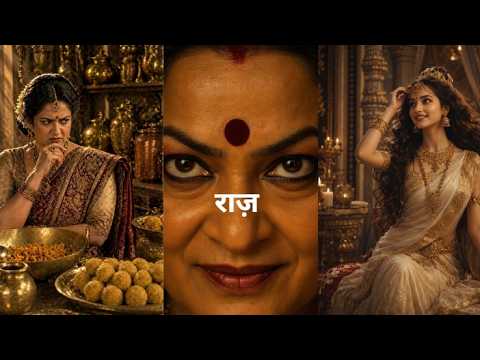
Devotion needs understanding
Bhakti is most complete when love is accompanied by wisdom rather than sentiment alone.
BHAGAVATA TRADITION · BHAKTI, GYAN & VAIRAGYA
नारद ने कलियुग में क्या देखा?
A radiant young woman. Two ancient sons. A mystery that revealed the spiritual crisis of an age.
THE STORY
During his journey through Kaliyuga, Narad Muni witnesses a scene he cannot explain: a beautiful young woman desperately trying to awaken two frail old men beside her.
She is Bhakti—devotion itself. The old men are her sons, Gyan and Vairagya: spiritual wisdom and detachment. But why has devotion remained young while wisdom and detachment have withered?
The answer becomes a profound portrait of the age we live in—and a reminder that the path of devotion may still restore what Kaliyuga has weakened.
The image unsettles Narad Muni because the natural order appears reversed. Parents ordinarily age before their children, yet Bhakti is radiant while her sons can barely move. The scene converts an abstract diagnosis of Kaliyuga into a family crisis that can be seen and felt.
Bhakti may remain youthful because devotion can still arise quickly in an age of confusion. Emotion, longing and the repetition of a divine name remain accessible even when disciplined study and renunciation feel remote. But devotion separated entirely from understanding can become fragile, while knowledge without living devotion can become dry.
Gyan represents more than information. It is wisdom capable of changing how a person sees the self and the world. Vairagya is not indifference or rejection of responsibility; it is the freedom to hold worldly experience without being possessed by it. Their weakness suggests that both insight and detachment require nourishment.
Narad’s search for a remedy eventually points toward the hearing of the Bhagavata. Katha is therefore not mere entertainment in this tradition. Attentive listening becomes a practice through which devotion is clarified, wisdom is awakened and detachment regains strength.
The allegory also prevents despair about Kaliyuga. The age is spiritually difficult, but it is not abandoned. The very act of recognizing the imbalance becomes the beginning of restoration, and Bhakti’s concern for her sons shows that devotion ultimately seeks the company of both wisdom and freedom.
INTERPRETATION · कथा का अर्थ
Bhakti is most complete when love is accompanied by wisdom rather than sentiment alone.
Vairagya does not demand coldness; it loosens the grip of possession, fear and compulsive desire.
In the katha tradition, hearing a sacred story attentively is itself a way of reshaping consciousness.
SOURCE NOTES · स्रोत
The allegory of Bhakti and her aged sons Gyan and Vairagya is associated with the Bhagavata Mahatmya tradition.
The Mahatmya literature praises attentive hearing of the Bhagavata as the remedy offered to Narad Muni.
The figures are personifications: their ages and physical condition express the spiritual condition of an era rather than ordinary biography.
Spiritual Suruchi presents a researched narrative retelling. It is not a critical edition or a word-for-word translation of scripture.
CONTINUE EXPLORING